


Moonga Stone (Red Coral)
Buyer Beware Guidelines for Moonga Gemstone
Choose natural, untreated coral: Pick a natural and untreated Moonga gemstone. It has its natural look and quality.
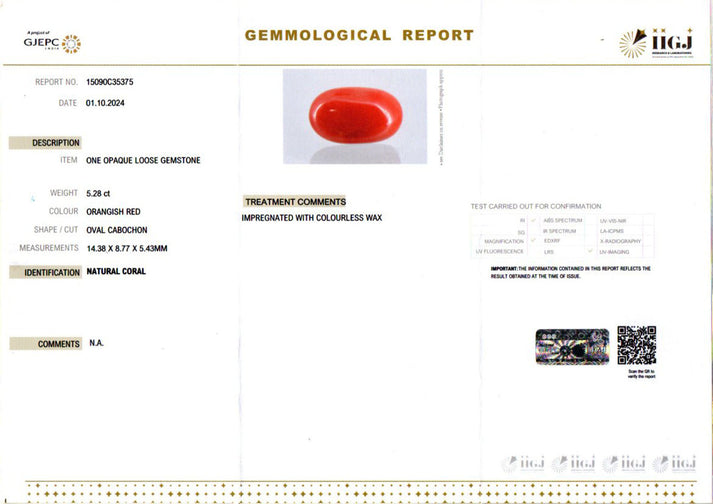
Check for certification (GIA, IGI, etc.): Always check a trusted lab certificate. It helps confirm the Red Coral is real and shows its treatment status.
Choose the right weight: The right Red Coral weight depends on your birth chart and astrological needs. An astrologer can help you choose the right weight.
Check seller reputation and return policy: Before buying Red Coral online, check the seller reviews, ratings, certificate, and return policy.




 Vendor: MyRatna
Red Coral - 5.80 Carat (6.41 Ratti - Moonga)
SKU: CC-5980
Origin: Italy
Regular price Rs. 7,540Sale price Rs. 7,540 Regular priceUnit price per
 Vendor: MyRatna
Red Coral - 5.09 Carat (5.62 Ratti - Moonga)
SKU: CC-5979
Origin: Italy
Regular price Rs. 5,599Sale price Rs. 5,599 Regular priceUnit price per
 Vendor: MyRatna
Red Coral - 4.15 Carat (4.59 Ratti - Moonga)
SKU: CC-5978
Origin: Italy
Regular price Rs. 4,150Sale price Rs. 4,150 Regular priceUnit price per
 Vendor: MyRatna
Red Coral - 5.67 Carat (6.27 Ratti - Moonga)
SKU: CC-5977
Origin: Italy
Regular price Rs. 4,082Sale price Rs. 4,082 Regular priceUnit price per
 Vendor: MyRatna
Red Coral - 5.84 Carat (6.45 Ratti - Moonga)
SKU: CC-5976
Origin: Italy
Regular price Rs. 3,504Sale price Rs. 3,504 Regular priceUnit price per
 Vendor: MyRatna
Red Coral - 6.38 Carat (7.05 Ratti - Moonga)
SKU: CC-5975
Origin: Italy
Regular price Rs. 6,380Sale price Rs. 6,380 Regular priceUnit price per
 Vendor: MyRatna
Red Coral - 4.38 Carat (4.84 Ratti - Moonga)
SKU: CC-5974
Origin: Italy
Regular price Rs. 3,285Sale price Rs. 3,285 Regular priceUnit price per
 Vendor: MyRatna
Red Coral - 6.12 Carat (6.76 Ratti - Moonga)
SKU: CC-5973
Origin: Italy
Regular price Rs. 11,016Sale price Rs. 11,016 Regular priceUnit price per
 Vendor: MyRatna
Red Coral - 5.06 Carat (5.59 Ratti - Moonga)
SKU: CC-5972
Origin: Italy
Regular price Rs. 4,048Sale price Rs. 4,048 Regular priceUnit price per
 Vendor: MyRatna
Red Coral - 5.31 Carat (5.87 Ratti - Moonga)
SKU: CC-5971
Origin: Italy
Regular price Rs. 5,045Sale price Rs. 5,045 Regular priceUnit price per
 Vendor: MyRatna
Red Coral - 5.36 Carat (5.92 Ratti - Moonga)
SKU: CC-5970
Origin: Italy
Regular price Rs. 3,484Sale price Rs. 3,484 Regular priceUnit price per
 Vendor: MyRatna
Red Coral - 3.43 Carat (3.79 Ratti - Moonga)
SKU: CC-5969
Origin: Italy
Regular price Rs. 2,058Sale price Rs. 2,058 Regular priceUnit price per
 Vendor: MyRatna
Red Coral - 3.51 Carat (3.88 Ratti - Moonga)
SKU: CC-5968
Origin: Italy
Regular price Rs. 2,808Sale price Rs. 2,808 Regular priceUnit price per
 Vendor: MyRatna
Red Coral - 3.17 Carat (3.50 Ratti - Moonga)
SKU: CC-5967
Origin: Italy
Regular price Rs. 2,695Sale price Rs. 2,695 Regular priceUnit price per
 Vendor: MyRatna
Red Coral - 5.51 Carat (6.09 Ratti - Moonga)
SKU: CC-5966
Origin: Italy
Regular price Rs. 4,959Sale price Rs. 4,959 Regular priceUnit price per
 Vendor: MyRatna
Red Coral - 5.72 Carat (6.32 Ratti - Moonga)
SKU: CC-5965
Origin: Italy
Regular price Rs. 5,720Sale price Rs. 5,720 Regular priceUnit price per
 Vendor: MyRatna
Red Coral - 4.16 Carat (4.60 Ratti - Moonga)
SKU: CC-5964
Origin: Italy
Regular price Rs. 2,704Sale price Rs. 2,704 Regular priceUnit price per
 Vendor: MyRatna
Red Coral - 4.72 Carat (5.22 Ratti - Moonga)
SKU: CC-5963
Origin: Italy
Regular price Rs. 4,012Sale price Rs. 4,012 Regular priceUnit price per
 Vendor: MyRatna
Red Coral - 6.05 Carat (6.69 Ratti - Moonga)
SKU: CC-5962
Origin: Italy
Regular price Rs. 9,075Sale price Rs. 9,075 Regular priceUnit price per
 Vendor: MyRatna
Red Coral - 3.64 Carat (4.02 Ratti - Moonga)
SKU: CC-5961
Origin: Italy
Regular price Rs. 2,730Sale price Rs. 2,730 Regular priceUnit price per
 Vendor: MyRatna
Red Coral - 5.48 Carat (6.06 Ratti - Moonga)
SKU: CC-5960
Origin: Italy
Regular price Rs. 4,658Sale price Rs. 4,658 Regular priceUnit price per
 Vendor: MyRatna
Red Coral - 6.19 Carat (6.84 Ratti - Moonga)
SKU: CC-5959
Origin: Italy
Regular price Rs. 8,357Sale price Rs. 8,357 Regular priceUnit price per
 Vendor: MyRatna
Red Coral - 4.14 Carat (4.57 Ratti - Moonga)
SKU: CC-5958
Origin: Italy
Regular price Rs. 2,484Sale price Rs. 2,484 Regular priceUnit price per
 Vendor: MyRatna
Red Coral - 3.50 Carat (3.87 Ratti - Moonga)
SKU: CC-5957
Origin: Italy
Regular price Rs. 2,450Sale price Rs. 2,450 Regular priceUnit price per
 Vendor: MyRatna
Red Coral - 4.01 Carat (4.43 Ratti - Moonga)
SKU: CC-5956
Origin: Italy
Regular price Rs. 2,807Sale price Rs. 2,807 Regular priceUnit price per
 Vendor: MyRatna
Red Coral - 5.23 Carat (5.78 Ratti - Moonga)
SKU: CC-5955
Origin: Italy
Regular price Rs. 6,276Sale price Rs. 6,276 Regular priceUnit price per
 Vendor: MyRatna
Red Coral - 3.68 Carat (4.07 Ratti - Moonga)
SKU: CC-5954
Origin: Italy
Regular price Rs. 2,392Sale price Rs. 2,392 Regular priceUnit price per
 Vendor: MyRatna
Red Coral - 6.72 Carat (7.43 Ratti - Moonga)
SKU: CC-5953
Origin: Italy
Regular price Rs. 8,064Sale price Rs. 8,064 Regular priceUnit price per

 Vendor: MyRatna
Red Coral - 26.38 Carat (29.15 Ratti - Moonga)
SKU: CC-5952
Origin: Italy
Regular price Rs. 79,140Sale price Rs. 79,140 Regular priceUnit price per

 Vendor: MyRatna
Red Coral - 3.89 Carat (4.30 Ratti - Moonga)
SKU: CC-5951
Origin: Italy
Regular price Rs. 17,505Sale price Rs. 17,505 Regular priceUnit price per
 Vendor: MyRatna
Red Coral - 5.41 Carat (5.98 Ratti - Moonga)
SKU: CC-5950
Origin: Italy
Regular price Rs. 27,050Sale price Rs. 27,050 Regular priceUnit price per
 Vendor: MyRatna
Red Coral - 3.64 Carat (4.02 Ratti - Moonga)
SKU: CC-5949
Origin: Italy
Regular price Rs. 14,560Sale price Rs. 14,560 Regular priceUnit price per
 Vendor: MyRatna
Italian Red Coral - 3.54 Carat Limited Quality TC-5270
SKU: TC-5270
Origin: Italy
Regular price Rs. 5,965Sale price Rs. 5,965 Regular priceUnit price per
 Vendor: MyRatna
Italian Red Coral - 3.78 Carat Prime Quality TC-5200
SKU: TC-5200
Origin: Italy
Regular price Rs. 4,460Sale price Rs. 4,460 Regular priceUnit price per
 Vendor: MyRatna
Red Coral - 5.03 Carat (5.56 Ratti - Moonga)
SKU: TC-5363
Origin: Italy
Regular price Rs. 20,532Sale price Rs. 20,532 Regular priceUnit price per
 Vendor: MyRatna
Red Coral - 12.25 Carat (13.54 Ratti - Moonga)
SKU: TC-5329
Origin: Italy
Regular price Rs. 56,273Sale price Rs. 56,273 Regular priceUnit price per
 Vendor: MyRatna
Red Coral - 8.86 Carat (9.79 Ratti - Moonga)
SKU: TC-5328
Origin: Italy
Regular price Rs. 28,476Sale price Rs. 28,476 Regular priceUnit price per
 Vendor: MyRatna
Red Coral - 16.12 Carat (17.81 Ratti - Moonga)
SKU: TC-5327
Origin: Italy
Regular price Rs. 58,005Sale price Rs. 58,005 Regular priceUnit price per
 Vendor: MyRatna
Red Coral - 11.37 Carat (12.56 Ratti - Moonga)
SKU: TC-5326
Origin: Italy
Regular price Rs. 31,339Sale price Rs. 31,339 Regular priceUnit price per
 Vendor: MyRatna
Red Coral - 13.12 Carat (14.50 Ratti - Moonga)
SKU: TC-5325
Origin: Italy
Regular price Rs. 56,234Sale price Rs. 56,234 Regular priceUnit price per
 Vendor: MyRatna
Red Coral - 16.59 Carat (18.33 Ratti - Moonga)
SKU: TC-5323
Origin: Italy
Regular price Rs. 63,477Sale price Rs. 63,477 Regular priceUnit price per
 Vendor: MyRatna
Red Coral - 5.12 Carat (5.66 Ratti - Moonga)
SKU: CC-5852
Origin: Italy
Regular price Rs. 15,671Sale price Rs. 15,671 Regular priceUnit price per
 Vendor: MyRatna
Red Coral - 5.53 Carat (6.11 Ratti - Moonga)
SKU: CC-5847
Origin: Italy
Regular price Rs. 16,926Sale price Rs. 16,926 Regular priceUnit price per
 Vendor: MyRatna
Red Coral - 5.45 Carat (6.02 Ratti - Moonga)
SKU: CC-5849
Origin: Italy
Regular price Rs. 16,681Sale price Rs. 16,681 Regular priceUnit price per

 Vendor: MyRatna
Red Coral - 5.28 Carat (5.83 Ratti - Moonga)
SKU: CC-5846
Origin: Italy
Regular price Rs. 18,107Sale price Rs. 18,107 Regular priceUnit price per
 Vendor: MyRatna
Red Coral - 5.26 Carat (5.81 Ratti - Moonga)
SKU: CC-5843
Origin: Italy
Regular price Rs. 16,100Sale price Rs. 16,100 Regular priceUnit price per
 Vendor: MyRatna
Red Coral - 4.17 Carat (4.61 Ratti - Moonga)
SKU: CC-5842
Origin: Italy
Regular price Rs. 8,175Sale price Rs. 8,175 Regular priceUnit price per
 Vendor: MyRatna
Red Coral - 3.81 Carat (4.21 Ratti - Moonga)
SKU: TC-5050
Origin: Italy
Regular price Rs. 5,837Sale price Rs. 5,837 Regular priceUnit price per


Need Help


